
Ask most adults what they wish they had learned earlier in life, and money is almost always in the top three. How to budget. How to save with a goal in mind. How to tell the difference between a want and a need. How to understand the quiet power of spending less than you earn. These are not complicated concepts — but they are ones that most of us had to figure out the hard way, as adults, often after making expensive mistakes.
The good news is that we do not have to hand that struggle to our children. Financial literacy — the ability to understand and manage money well — is a skill that can be taught, practiced, and built from childhood. And in 2026, with digital wallets, instant purchases, and “buy now, pay later” schemes woven into daily life, the need to teach children how money actually works has never been more urgent or more practical.
For High Country families already committed to intentional, values-driven living, teaching kids about money is a natural extension of the same principles that guide everything else: be thoughtful about what you consume, understand the value of what you have, and make choices that reflect what actually matters to you.
Why Financial Literacy Starts Earlier Than You Think
Many parents delay money conversations because they feel complicated or because they assume young children cannot grasp financial concepts. The research says otherwise. Studies from Cambridge University suggest that core money habits and attitudes are formed as early as age seven — and according to the Money and Pensions Service, children begin absorbing financial skills and habits between ages three and seven. The foundation is being laid far earlier than most parents realize, with or without intentional guidance.
Children who are not taught about money do not stay financially neutral — they absorb money messages from what they observe. They watch parents swipe cards and assume money is unlimited. They hear “we can’t afford that” without understanding what it means. They receive birthday cash and spend it immediately because no one has shown them an alternative. Country Bank’s 2026 financial literacy guide makes it clear: financial education does not begin with spreadsheets — it begins with simple, real-life discussions that happen naturally in the course of daily life.
The goal is not to raise mini-accountants. It is to raise children who have a healthy, confident, and intentional relationship with money — who know how to earn it, allocate it, save for something meaningful, and give generously. Those are life skills that will serve them in every decade ahead.
The Save, Spend, Give Framework
For young children, the most effective and research-backed money teaching tool is also the simplest: three clear jars labeled Save, Spend, and Give. This system — recommended consistently by financial educators and child development researchers — works because it makes abstract money concepts visible and concrete. Children can see their money. They can watch it grow. They can understand, in physical terms, that money divides into different purposes.
How It Works in Practice
When a child receives money — an allowance, a birthday gift, payment for a small job — they divide it between the three jars. A simple starting framework is 50 percent for spending, 40 percent for saving, and 10 percent for giving. The exact percentages matter less than the habit of dividing intentionally rather than spending everything at once.
The Spend jar covers small, immediate purchases — a treat, a sticker pack, a book. The Save jar builds toward something larger that requires patience — a toy they really want, a game, an experience. The Give jar introduces the concept of generosity as a built-in financial value, not an afterthought. Children who grow up with the Give jar tend to approach generosity with a naturalness that children taught about giving only abstractly often do not.
Making the Saving Goal Real
The Save jar works best when it is tied to a specific, visible goal. Help your child identify something they genuinely want — not something you are offering to buy, but something they have chosen — and calculate together how long it will take to save for it. A child who waits eight weeks to buy something they chose and saved for has learned something about delayed gratification that no lecture can teach. And the satisfaction of that purchase — made with their own money, through their own patience — is disproportionately greater than anything handed to them.

Age-by-Age Guide to Teaching Kids About Money
Financial literacy is not a single conversation. It is a series of age-appropriate lessons, experiences, and responsibilities that build on each other over the course of childhood. Here is how that progression looks in practice.
Early Childhood — Ages 3 to 6
At this age, the goal is simply making money tangible and introducing basic vocabulary. Use coins and cash rather than cards whenever possible — physical money is something young children can see, count, and understand in ways that a tap-to-pay transaction is not. Name the coins. Count them together. Let your child hand money to a cashier and receive change. Let them put their coins in the Save jar. The concepts of spending, saving, and choosing are all accessible at this age when introduced through play and real-life moments rather than formal instruction.
Elementary School — Ages 7 to 10
This is the age when intentional financial habits take root. Introducing a regular allowance at this stage — tied either to household contributions or given as a base amount with opportunities to earn extra — gives children a regular experience of managing money over time. The average allowance for a ten-year-old in 2026 is between $7 and $10 per week, according to family banking research, though the right amount for your family depends on what you intend the allowance to cover.
At this age, grocery shopping becomes one of the best money classrooms available. Let your child compare prices, calculate which option is the better value, and understand that the same basic product can come in wildly different price points. “Which cereal is a better deal?” is a real math problem and a real money lesson in one question. Involve them in understanding the family grocery budget — not to burden them, but to demystify the connection between money and daily life.
Tweens and the Real World of Money
By ages 11 to 13, children are capable of managing more complex financial concepts — and they are increasingly making real financial decisions online, whether parents are aware of it or not. In-app purchases, digital subscriptions, online gaming economies, and peer pressure around brand names and consumer status are all financial realities of the tween years.
This is a good age to introduce simple budgeting — a written or digital record of money coming in and going out. Help your tween plan for a larger purchase by working backward: how much do they need, how much do they earn or receive, and how many weeks will it take? Introduce the concept of needs versus wants not as a lecture but as a genuine conversation: “If you buy this now, you will not have enough for what you were saving for. Is this more important to you than that?” Those decisions — made with their own money and their own goals at stake — are the most effective financial education available.

Earning — The Lesson That Changes Everything
One of the most powerful money lessons a child can receive is the experience of earning. When children earn money — through age-appropriate jobs, neighborhood services, or small entrepreneurial ventures — they develop a relationship with money that is fundamentally different from children who only receive it. Earned money is valued differently. It is spent more thoughtfully. And the connection between effort and reward is one of the most durable lessons childhood can produce.
Age-Appropriate Earning Opportunities
For younger children, simple household tasks beyond their normal responsibilities — helping with a car wash, pulling weeds, organizing a pantry shelf — can earn a small payment. For older children and tweens, neighborhood opportunities open up: dog walking, lawn mowing, helping neighbors with tasks, selling something they have made. Oppenheimer’s 2026 financial literacy guide specifically encourages fostering entrepreneurial thinking by helping children identify ways to earn beyond traditional allowances — noting that entrepreneurship teaches valuable lessons about initiative, hard work, and financial independence.
In the High Country, where community bonds run deep and neighbors often know each other well, these opportunities are genuinely available to motivated children. A ten-year-old who earns their own money through real effort has learned something that no allowance alone can teach.
The Lemonade Stand Is Still the Best MBA
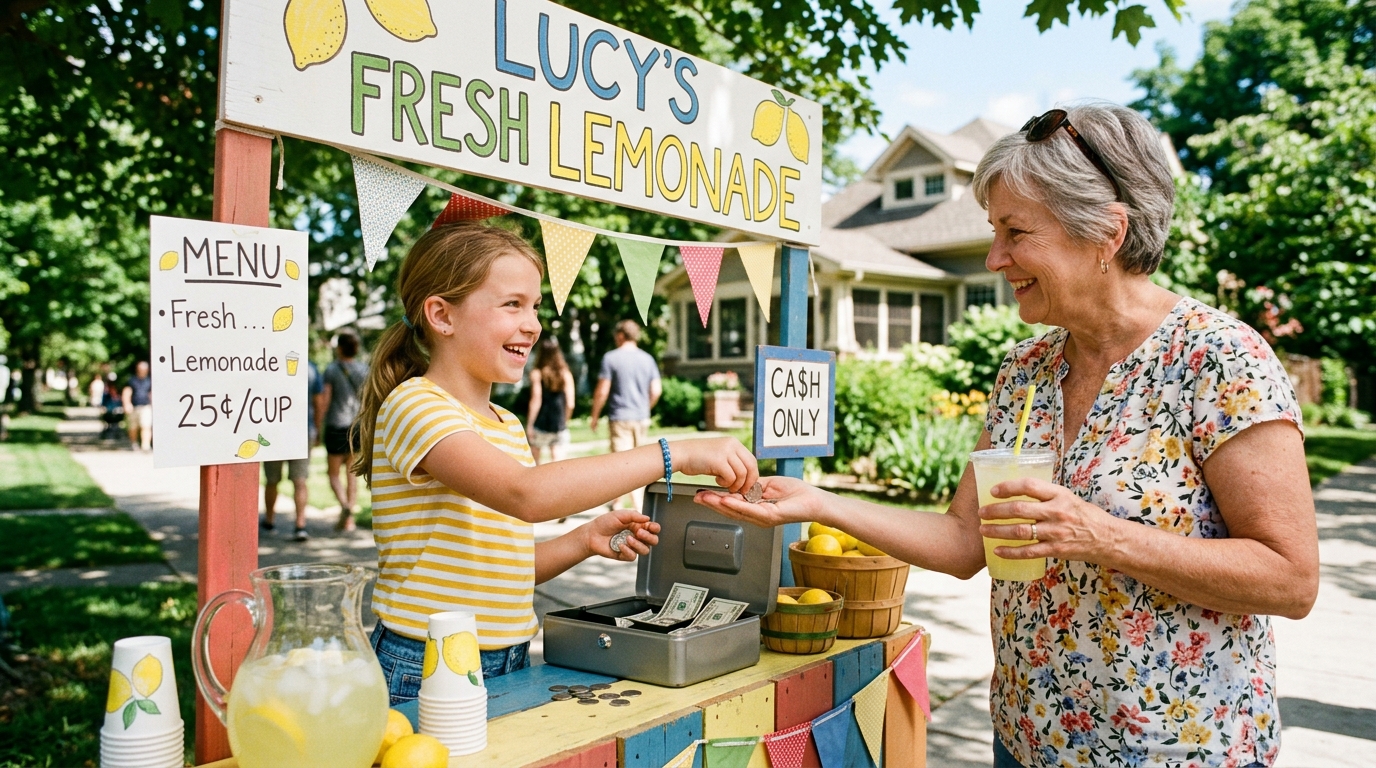
There is a reason the lemonade stand has survived as a cultural shorthand for childhood entrepreneurship: it works. A child who sets up a simple stand — buys supplies, prices their product, makes change, counts their profit — has been through a complete cycle of basic economics. The lessons are real, the stakes are small enough to be safe, and the experience of earning something from nothing is genuinely transformative. Do not underestimate it.
Talking About Money Without Making It Heavy
Many parents avoid money conversations because they carry their own financial anxiety, shame, or uncertainty into the room. But children absorb financial anxiety just as readily as financial wisdom — and the goal is to raise children who feel capable and confident around money, not fearful of it.
Normalize Money Talk
The families that raise the most financially capable children are the ones where money is talked about matter-of-factly as part of daily life. Not dramatically, not secretively, but ordinarily. “We are choosing this brand because it costs less and works just as well.” “We are saving for a trip this summer so we are spending less on other things right now.” These are not heavy conversations. They are the quiet, consistent money education that happens in homes where adults talk about their choices out loud.
Connect Money to Values
The most lasting money lessons are the ones connected to what the family actually cares about. Generosity. Stewardship. Working hard for something meaningful. Choosing experiences over things. When children understand that money is a tool for living according to what they value — not a measure of status or a source of anxiety — they develop a healthy and functional relationship with it that will serve them for life.
If you are also working on building your children’s broader life skills alongside financial literacy, our post on teaching kids to cook with age-by-age kitchen skills is a natural companion — because cooking, budgeting, and managing resources all build the same foundational competence: a child who can take care of themselves and contribute meaningfully to the household.
The Long View — What You Are Really Building
Teaching children about money is not really about money. It is about the capacity to make intentional choices, delay gratification, take responsibility for their decisions, and understand that what they do with what they have reflects who they are and what they care about.
In the High Country, where intentional living is already part of the culture — where people choose quality over quantity, community over status, and the long view over the quick fix — raising financially literate children is not a departure from the values already shaping your family. It is an expression of them.
Start with three jars and a weekly allowance. Let your child make a real purchase with real money they saved themselves. Bring them to the farmers market and let them compare prices. Give them a small job and let them earn something. These are not complicated interventions. They are the ordinary, consistent practices that add up, over years, to a child who knows how to handle money — and a grown-up who does not have to learn the hard way.
And for the days when managing the family budget feels like its own full-time job, our post on celebrating small wins with your kids is a good reminder that the quiet progress happening in your household — including every money lesson that sticks — is worth noticing.