
Picture this: your third-grader comes home and tells you that almost everyone in their class has a smartphone. Your fifth-grader says they feel left out because they cannot join the group chat. Your tween insists that not having a phone is social torture. Sound familiar?
For many High Country families, the smartphone decision has become one of the most loaded and most contested parenting choices of the decade. The pressure to hand over the device is real — and it comes from everywhere: from kids, from other parents, from the unspoken social norms that have made smartphones standard equipment for children as young as eight or nine.
The Wait Until 8th movement exists precisely to push back against that pressure. And with over 147,000 families nationwide who have signed the pledge, it is no longer a fringe idea. It is a growing, community-powered movement that is changing the conversation — and the culture — around smartphones and children in communities across the country.
Here is everything High Country families need to know about it.
What the Wait Until 8th Pledge Actually Is
The Wait Until 8th pledge is a simple, collective agreement among parents: I agree not to give my child a smartphone until at least the end of 8th grade, as long as at least 10 families from my child’s grade and school pledge to do the same.
That last part is the key design feature that makes it work. The pledge is not asking any one family to stand alone against the current. It is asking families to band together so that no single child is left out while everyone else has a phone. When ten families in the same grade at the same school commit, the pledge activates — and parents receive contact information for the other participating families, creating an instant support network of like-minded households.
The movement was founded by Austin, Texas mom Brooke Shannon, who noticed smartphones appearing in her children’s elementary school and began talking to other parents about her concerns. What started as a conversation in one school community has now been activated at more than 58,000 schools across the United States, with chapters forming in communities from Nevada to Massachusetts to the Carolinas.
Importantly, the pledge is for smartphones only. Families can still use basic phones, GPS-enabled watches, or simple communication devices that allow children to stay in contact with parents without carrying a full internet-connected smartphone. The goal is not to cut children off from all communication — it is to delay unrestricted internet access and social media exposure until they are developmentally more prepared to handle it.
Why This Movement Exists — The Research Behind the Decision
The Wait Until 8th movement did not emerge from technophobia or nostalgia. It emerged from a growing body of evidence linking early smartphone access to real and measurable harms in children’s mental health, social development, and academic performance.
The average age at which American children receive their first smartphone is ten years old — which means most kids enter middle school already carrying a device with full access to social media, messaging apps, and the entire internet. Child psychologists have raised consistent concerns about what this means for developing brains, and the data on adolescent mental health over the past decade has made those concerns increasingly hard to dismiss.
What Smartphones Are Doing to Elementary and Middle Schoolers
The front-facing camera alone has fundamentally changed how many children — especially girls — see themselves. Child psychologists working with the Wait Until 8th movement argue that features like front-facing cameras and easy access to social media are directly linked to increased anxiety in young people. When a child can compare their appearance to filtered, curated images of peers at any moment of the day, the psychological toll accumulates quickly.
Beyond appearance anxiety, research consistently links early smartphone use to disrupted sleep, shortened attention spans, reduced face-to-face social skill development, increased cyberbullying exposure, and greater risk of encountering inappropriate or harmful content. These are not hypothetical concerns. They are the documented experiences of children who received smartphones before they had the maturity to navigate them safely.
The “But Everyone Has One” Problem — Solved
The most common reason parents give smartphones to children earlier than they planned is social pressure — both from children who do not want to be left out, and from parents who do not want to be the family that stands alone. “Every other kid has one” is one of the most powerful arguments in a child’s arsenal, and it is often at least partly true.
The Wait Until 8th pledge directly addresses this by removing the isolation factor. As one Pennsylvania mom explained, the pledge works because it means your child is not the only one without a phone — and that changes everything. When ten families in the same grade commit together, no single child bears the social cost of the decision alone.

What Kids Gain When They Wait
The case for delaying smartphones is not just about what children are protected from — it is equally about what they gain in the years when they are not managing a device and its social demands.
Stronger Face-to-Face Social Skills
The elementary and middle school years are a critical window for social development. Learning to read facial expressions, navigate conflict in real time, make eye contact, tolerate silence, and repair friendships after disagreements — these skills are built through direct, in-person interaction. They are also the skills that get crowded out when children are managing group chats, social media feeds, and the performance of an online identity at the same time.
Children who delay smartphone access during this window arrive at high school with stronger in-person social skills — and with a less complicated relationship with their own identity and self-worth.
More Outdoor Time and Independent Play
The connection between smartphone access and reduced outdoor play is well-documented and significant. Children without smartphones spend more time outside, engage in more imaginative and independent play, and develop the physical confidence and risk tolerance that come from unstructured outdoor time. In the High Country, where the mountains, trails, and open spaces are right outside the door, this is a particularly meaningful benefit. The environment we live in is one of the best possible arguments for keeping childhood phone-free a little longer.
Better Sleep — With Real Consequences
Smartphones in bedrooms are one of the most consistent predictors of poor sleep quality in children and adolescents. Blue light suppresses melatonin production. Notifications interrupt sleep cycles. Social anxiety about unanswered messages keeps minds active late into the night. Children who do not have smartphones are significantly more likely to sleep the hours their developing brains require — and the downstream effects of good sleep on mood, learning, behavior, and mental health are profound.
How to Have the Conversation With Your Child
Taking the pledge is the easy part. Explaining the decision to your child — especially one who has been asking for a phone — requires more thought and more honesty.
Lead With Love, Not Rules
The most effective conversations about smartphone delays start from a place of genuine care rather than authority. “I love you and I want to protect your childhood” lands differently than “Because I said so.” Be honest with your child about what the research shows, in age-appropriate terms. Tell them that you are not saying no forever — you are saying not yet, and here is why.
Acknowledge That It Is Hard
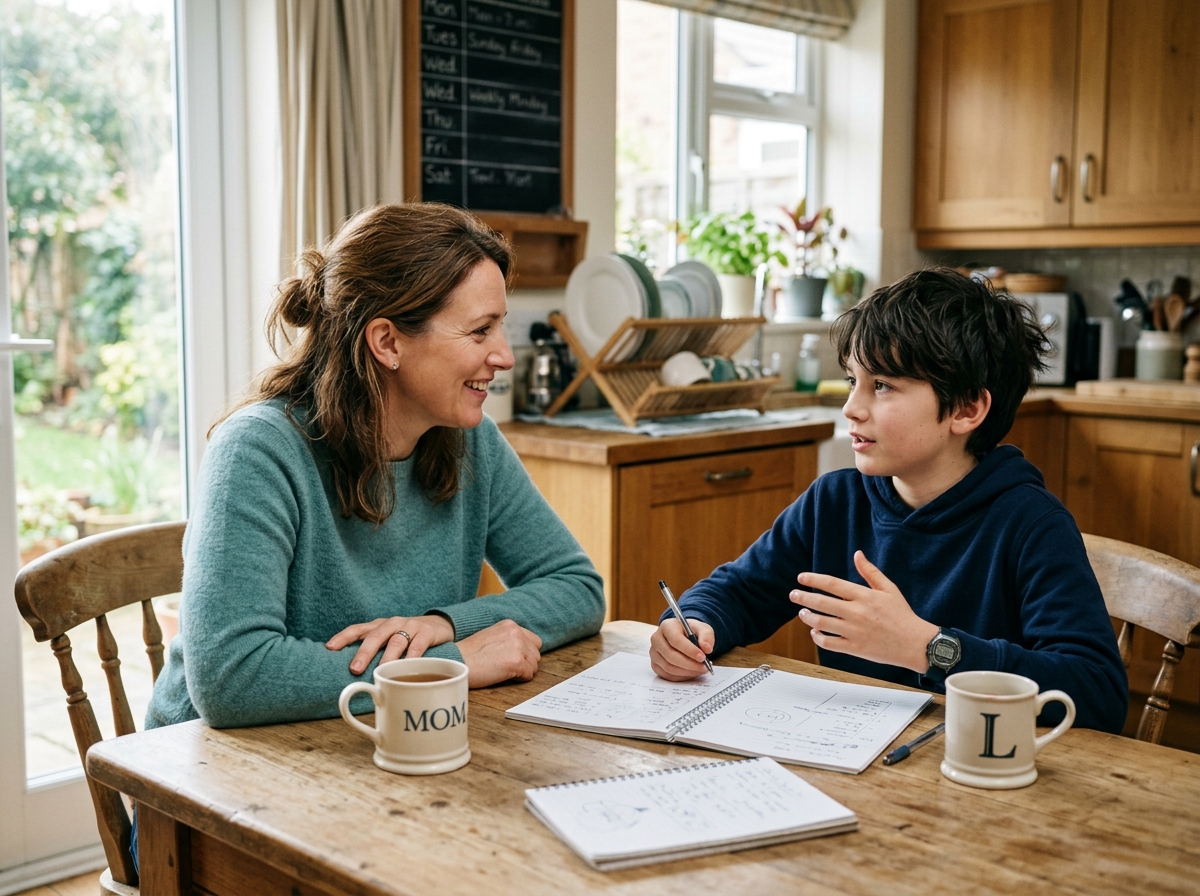
Do not minimize the social reality your child is navigating. For a ten-year-old, being left out of a group chat is genuinely painful. Acknowledging that — “I know this feels unfair and I know it’s hard” — while holding the line sends a powerful message: your feelings matter, and the boundary still stands. That combination of empathy and firmness is the foundation of the kind of hybrid parenting approach that actually works for today’s kids. Our post on hybrid parenting and what it actually looks like day to day explores exactly that balance.
Offer Real Alternatives
Many families who take the Wait Until 8th pledge offer their children a basic phone or a GPS-enabled smartwatch as an alternative — a device that allows communication with parents without providing full internet access or social media. This addresses the legitimate safety concern many children and parents share while avoiding the harms of a full smartphone. Being concrete about what IS available — rather than only what is not — helps children feel heard rather than simply restricted.
How to Take the Pledge and Build Community Around It
Taking the pledge is straightforward. Visit waituntil8th.org, click “Take the Pledge,” and enter your child’s school name, zip code, and grade level. You will receive a confirmation email, followed by a group notification once at least nine other families from the same grade and school have joined. From that point, you will receive weekly updates as additional families commit.
Bringing It to Your Child’s School
One of the most powerful things a High Country family can do is not just take the pledge privately but actively bring it to their school community. Print-ready materials, talking points for parent conversations, and guidance for approaching school administrators are all available through the Wait Until 8th website. Communities where parents have organized around the pledge — sharing it at school pickup, mentioning it in parent group chats, raising it at PTA meetings — have seen dramatically faster activation than those where families wait for others to take the lead.
The Power of Doing It Together
For many families, the most valuable part of the pledge is not the document itself but the community it creates. Knowing that other families in your child’s grade are making the same decision — and having their contact information — makes the commitment significantly easier to maintain when the social pressure intensifies. You are no longer a lone holdout. You are part of a deliberate community of parents who decided, together, that childhood deserves a little more time to be childhood.
If you are also working to reduce the digital pressure on your family more broadly, our guide to building a family tech contract that actually sticks gives you a practical framework for setting household expectations around all devices — not just smartphones.

One Decision That Changes the Whole Conversation
The smartphone decision is one of the few parenting choices where the individual option and the collective option are genuinely different things. One family saying no is hard. Ten families saying not yet together is something else entirely — it is a community saying, collectively, that the childhood years are worth protecting.
In the High Country, where community has always mattered and where the natural world offers children something no algorithm can replicate, the Wait Until 8th pledge is a natural fit. It is not anti-technology. It is pro-childhood. And right now, with the mental health data pointing clearly in one direction and the pressure to hand over the phone pointing in another, it is a decision more and more families are making — and not regretting.
The pledge takes two minutes to sign. The childhood it protects lasts much longer than that.