It started with a tote bag and a TikTok video. In 2025, a content creator named Sierra Campbell posted a simple clip showing the contents of what she called her “analog bag” — knitting materials, crossword puzzles, a watercolor set, a Polaroid camera — and explained how she used these offline activities to replace the habit of reaching for her phone. Within months, #analogbag had become one of the most searched and shared trends of 2026, spreading from social media feeds to international news coverage and into the daily routines of families everywhere.
For High Country moms already leaning into the slow childhood movement and intentional living, the analog bag is not a shocking idea. It is a name for something many of us have been instinctively moving toward — giving our kids something real to reach for when boredom hits, instead of defaulting to a screen. And the research behind why it works is worth understanding, because it helps explain exactly how to build one that your kids will actually use.
What the Analog Bag Trend Actually Is
An analog bag is exactly what it sounds like — a physical bag, basket, or tote filled entirely with non-digital, non-connected items. Books, notebooks, craft supplies, card games, puzzles, drawing materials, small projects in progress. The point is not the specific items. The point is the behavioral architecture behind it.
Reader’s Digest described it plainly: analog bags are less about the activity inside and more about doing something that intentionally disconnects you from digital life. When a child — or a parent — reaches for their phone out of boredom or habit, the analog bag offers a physical alternative that is already curated, already within reach, and already set up for success. No willpower required. No apps to delete. No dramatic lifestyle changes. Just a bag in the corner of the room with things worth doing inside it.
What makes the trend psychologically meaningful is the concept of phone reflex replacement. The urge to scroll is a deeply conditioned habit loop — boredom triggers a reach, the reach finds the phone, and the scroll begins. The analog bag interrupts that loop at the exact moment it activates by putting something else physically in the way. Something tactile, creative, and genuinely engaging.
Why the Analog Bag Works
The trend resonated so strongly because it solves a real problem in a genuinely simple way. But there is solid psychological and developmental research behind why it works — especially for children.
Tactile Activity Engages the Brain Differently
Dr. Marie-Anne Sergerie, a psychologist and cyberaddiction specialist who has commented on the trend, notes that analog activities require a different kind of focused, sustained attention than screen-based entertainment. Drawing, assembling a puzzle, knitting, writing in a journal — these activities engage fine motor skills, creative thinking, and quiet concentration in ways that passive screen consumption does not. For children, this kind of engaged attention is also the foundation of the executive function skills — focus, patience, self-direction — that matter enormously for their development.
A psychology professor at the University of Waterloo called the trend “quite a wonderful thing to engage in” as a mindfulness practice, noting that the key is making it a consistent practice rather than a one-time experiment.
It Works Because It Is Already There
One of the most common failures of screen time reduction strategies is that they focus entirely on removal — take the tablet away, set a timer, restrict access — without replacing the boredom gap with something equally accessible. A child who is told “no more screens” and then left with nothing within reach will simply find another way to the screen. The analog bag solves the replacement problem by making the offline option easier to reach than the phone. That is the entire mechanism, and it is deceptively simple.
As influencer Sierra Campbell described it: when the bag is visible, it becomes a reminder and a permission slip — “I’ve done something to set myself up for success. This is my phone replacement, so I can put it down and pick up something else.”

How to Build an Analog Bag for Your Kids
The best analog bag for a child is one they helped pack. Involving your kids in the process — taking them to choose a few items, asking what they want to work on or try — creates ownership and dramatically increases the chances that the bag will actually get used. Here is a practical framework for building one at any age.
Choose the Right Container
The container matters more than it might seem. It should be visually appealing, accessible, and dedicated — meaning it lives in a consistent spot and is not used for anything else. A canvas tote bag, a small wicker basket, a backpack, or a sturdy box all work well. The goal is that your child can see it from across the room and know exactly what it is for.
What to Include by Age
The contents of an analog bag should grow and evolve with your child. Here is a starting framework by age group:
Toddlers and Preschoolers (Ages 2 to 5)
- Board books and picture books
- Chunky crayons and a simple coloring book
- Small puzzles with large pieces
- Playdough or soft modeling clay
- Sticker books or felt activity sets
Early Elementary (Ages 6 to 9)
- Chapter books at their reading level
- A blank sketchbook and colored pencils
- Age-appropriate puzzle books — word searches, simple crosswords, dot-to-dots
- A small card game like Uno or Go Fish
- A beginner craft kit — friendship bracelets, origami, simple weaving
Tweens (Ages 10 to 13)
- A journal or bullet journal and good pens
- A novel or graphic novel they have chosen themselves
- A hobby kit — watercolors, embroidery, knitting, or sketching
- A deck of cards plus a book of card games
- A crossword or Sudoku book
- A disposable or instant film camera for capturing moments offline
The One Rule That Makes It Work
The bag should be self-refreshing. Once a book is finished, it gets replaced. Once a craft kit runs out of supplies, it gets restocked. Once your child has mastered a puzzle, a new one takes its place. A static bag that never changes will stop being used within weeks. Building in regular — even monthly — refreshes keeps it genuinely interesting and signals to your child that you are invested in making offline time worth their while.
Making It a Family Practice, Not Just a Kids’ Rule
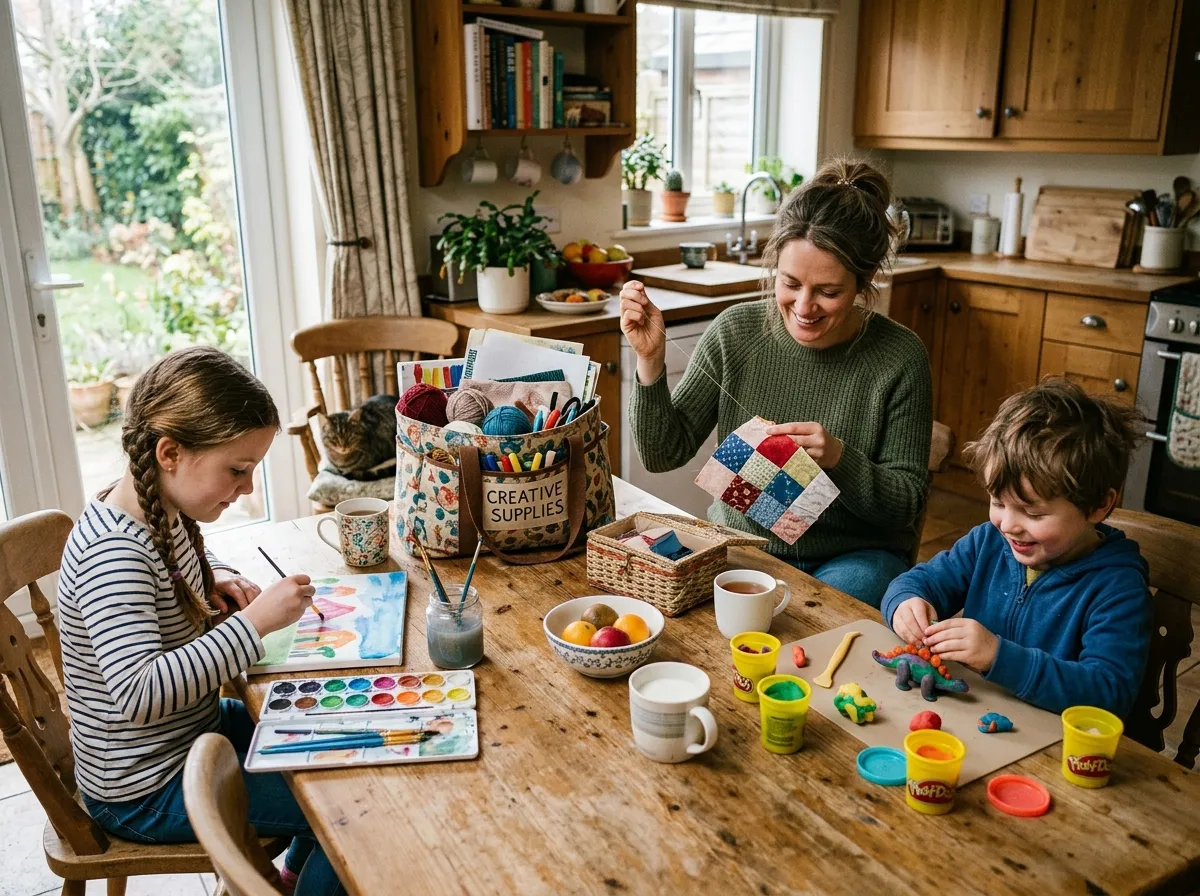
One of the most powerful aspects of the analog bag trend is that it works for adults too — and children notice. When a parent has their own analog bag, or their own offline ritual they genuinely reach for instead of their phone, the message shifts from “I am restricting you” to “this is how our family chooses to spend time.” That shift in framing changes everything about how children receive the practice.
Consider building a family analog basket that lives in the living room — a shared collection of activities that anyone can reach for. A puzzle in progress. A deck of cards. A communal sketchbook. A book of trivia questions. The point is not to be prescriptive about what anyone works on. It is simply to make the offline option the most visible and accessible one in the room.
If you are already working on reducing screen time as a family and want a structural framework to go alongside the analog bag, our post on building a family tech contract that actually sticks is a natural companion. The tech contract sets the rules; the analog bag makes those rules easy to live with.
The High Country Angle
In the High Country, the analog bag has a natural extension that families in cities do not always have as readily: the outdoors. Some of the best analog bag items are the ones that travel outside — a sketchbook for nature drawing, a field guide for identifying local birds or plants, a small magnifying glass for trail exploration, a disposable camera for capturing mountain views.
The same impulse that drives the analog bag trend — creating intentional, tactile alternatives to the scroll reflex — is the same impulse behind getting outside without a destination or a timer. Both practices are about reclaiming attention for something real, something present, something that leaves a child more grounded than they found them.

If you want to deepen that connection between offline activity and outdoor time, our piece on the slow childhood movement and the value of unstructured time explores why these practices matter developmentally and how to make them stick in a High Country family.
For families already navigating the balance between digital wellness and mountain life, our guide on ditching screens for summits covers the broader picture of how outdoor living and intentional tech use go hand in hand.
Start Small and Let It Grow
You do not need to build the perfect analog bag on day one. You need a bag, a few items your child will genuinely enjoy, and a consistent spot for it to live in your home. That is the whole starting point.
The Everygirl put it well: the analog bag is a screen-free boredom solution that requires fewer mindless scroll sessions and more intentional downtime — all without deleting apps or bricking your phone. It is not a punishment and it is not a dramatic reset. It is a tote bag with a book and some colored pencils in it, placed somewhere your child can see it.
That is enough to start. And in a world that is doing everything possible to capture your child’s attention for itself, something that redirects that attention toward something real is not a small thing. It is actually quite a big one.